
How to Build a Signal-Based Outbound Sequence in 2026
Cold outreach averages 3.43% reply rates. Signal-based outreach hits 5–18%. Stack two or three signals on the same account and you reach 25–40%. This guide covers how to build the sequence from detection to first message — including for APAC and MENA where standard tools return empty.


A signal-based outbound sequence has five components: (1) Signal detection — identify which observable business events indicate a buying window at an ICP-fit account; (2) Signal scoring — rank signals by conversion correlation, not volume; (3) Signal routing — automatically move high-scoring accounts into the right sequence without a manual triage step; (4) Signal-referenced messaging — write copy that names the specific trigger, not just the category; (5) Timing logic — act within the signal's half-life: funding rounds within 2–4 weeks, new VP hires within 30–90 days, pricing page visits within 5–10 days. The biggest failure mode is detection without activation — buying the signal tool, watching signals enter the CRM, and letting them expire while the team reviews them at the end of the week. For global markets, the additional challenge is that standard signal tools only cover English-language sources — the AHU registry filing in Indonesia or the funding announcement in Al-Iqtisadiah in Saudi Arabia never reach mainstream tools. A locally-sourced signal layer covers this gap.
85% of B2B purchases go to the vendor already on the Day One shortlist — formed during the 61% of the journey that passes before a buyer contacts anyone. Signal-based outbound is how you get there first.
From 1 million B2B software purchases: AI tool adoption (+46%), headcount growth 10%+ in 90 days (+38%), and recent purchases (+38%) are the strongest buying predictors. Job postings score +7%. Most teams over-index on job postings.
Not all signals are equal — the strongest ones have short windows. Three tiers:
Tier 1 — high-confidence, short window. Funding rounds, new VP/C-suite hires, technology adoption, compliance hiring surges, new subsidiary registrations. "New leaders clean house — the first 90 days is essentially open season on old vendor contracts." Act within the window or it closes.
Tier 2 — directional, medium window. 10%+ hiring surges in 90 days, 3+ pricing page visits in a week, G2 review activity, multiple senior contacts attending the same conference. Strong when combined with Tier 1 — weak alone.
Tier 3 — contextual only. Job postings, LinkedIn activity, content engagement. +7% buying correlation. Use to personalise, not to trigger.
A single signal is noise. Two or three on the same account within a short window is a priority call. The highest-converting pair: recent funding + new VP of Sales hire.
For APAC and MENA teams: the same signal categories apply but the sources are local. A new subsidiary in Indonesia's AHU. A funding round in Vietnamese trade press. A Gulf compliance hire on a regional job board. These never reach mainstream tools. Pubrio's Expansion Signal layer generates 120,000+ daily buying indicators from local registries and local-language sources across 130+ countries — same signal categories, sourced locally.
How to build the sequence: five steps
Step 1 — Define your signal stack by ICP
Map signal types to the business event they indicate for your product:
- New VP of Sales hire → evaluating inherited tech stack within 90 days
- Series A or B funding → building infrastructure and operations for new scale
- 10%+ headcount growth in 90 days → entering a new phase that creates new category needs
- New subsidiary registration → committing to a new market with technology procurement requirements
- Regulatory compliance hiring → mandatory evaluation cycle with a known deadline
- Technology adoption announcement → adjacent procurement need in the next 30–90 days
- New subsidiary registration in a local registry (AHU, ACRA, MISA, DBD) → market entry committed; technology procurement already started — this signal appears in Pubrio's Expansion Signal layer weeks before it travels to any English-language tool
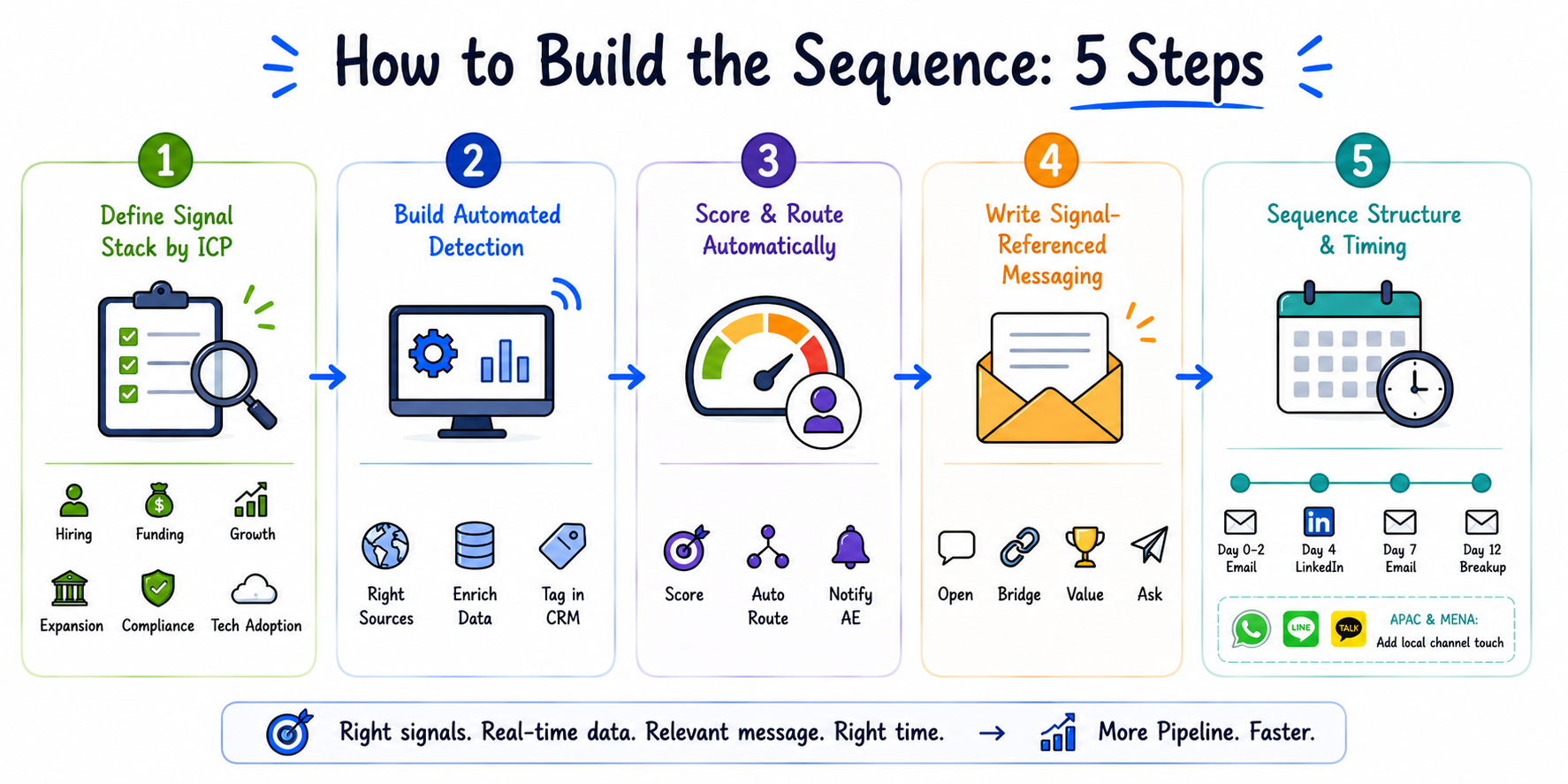
Step 2 — Build automated detection
Manual signal hunting works for the first 50 accounts. After that, the math collapses. A rep monitoring 200 target accounts manually loses 60% of high-signal events because detection latency exceeds the signal's half-life.
Detection requires infrastructure — and the right signal sources for your target geography.
For English-language markets: LinkedIn Sales Navigator or Apollo for job change and hiring signals + a sequencer (Lemlist, Smartlead) + CRM with signal-source tagging.
For APAC and MENA markets: Pubrio as the primary signal layer. 120,000+ daily Expansion Signals from local registries, regional job boards, and local-language trade press — the buying signals that LinkedIn and Bombora structurally cannot see. Connect Pubrio via API or Clay integration for waterfall enrichment that recovers contact data when single-source tools return empty.
For advanced teams: MCP-native integrations allow a RevOps engineer to wire Pubrio's Expansion Signals directly into outreach automations — OttoKit, Make.com, or n8n — without touching a UI.
CRM setup: create fields for "signal source" and "signal date." After 6 months this becomes an attribution model showing which signals produce the highest-value pipeline in your specific market.
Step 3 — Score and route automatically
The manual routing step is where most programmes fail — signals expire in the review queue while the team plans to act next week.
Score by conversion correlation from your own data, not industry averages. Set thresholds that auto-enroll accounts without human intervention. Intent-qualified prospecting lifts pipeline 30–50% and moves 34% faster — but only when automated routing removes the manual delay.
Step 4 — Write signal-referenced messaging
The single biggest mistake in signal-based outbound: leading with the signal. "I saw you just raised your Series B — congrats!" feels personalised to the rep and creepy to the prospect. The signal sets the timing. The message addresses the underlying problem the signal implies.
The framework:
Open: Reference the specific trigger without making it the hero. "Expanding to a new market is usually when [specific pain point] shows up for the first time."
Bridge: Connect the signal to a known problem your product solves. Not the signal itself — the implication of the signal.
Value: One specific outcome you have produced for a similar company at a similar moment. Not a case study — one sentence.
Ask: A low-commitment next step. Not a demo. Not a 30-minute call. A reply that lets them engage without committing.
Only 5% of senders personalise every email — there is still a massive competitive advantage for teams that do.
With Pubrio's local context — regional tech stack, local trade press mention, local employee count — the message becomes: "I saw your new subsidiary in AHU — companies entering Indonesia at this stage usually hit [specific pain] within 90 days." That specificity is what Pubrio's local data makes possible.
Step 5 — Sequence structure and follow-up timing
3–4 touches over 10–14 days. The signal window expires — a longer cold sequence cadence loses the timing advantage.
Day 0–2: Email on the signal implication — under 100 words. Day 4: LinkedIn connection, one-line context note, no pitch. Day 7: Second email with social proof from a similar company at a similar moment. Day 12: Breakup email. Short off-ramp.
For APAC and MENA: add a WhatsApp, Zalo, LINE, or KakaoTalk touch between Day 4 and Day 7. One message via the right channel outperforms three follow-up emails.
| Signal type | What it implies | Act within | Tier |
|---|---|---|---|
| Funding round announced | Capital available; infrastructure build-out underway | 2–4 weeks | 1 |
| New VP Sales / CRO hired | Evaluating inherited stack; 90-day window to replace tools | 30–90 days | 1 |
| New subsidiary registered | New market entry; technology procurement already started | 2–6 weeks | 1 |
| Compliance hiring surge | Regulatory evaluation cycle; mandatory procurement window | 30–60 days | 1 |
| 10%+ headcount growth in 90 days | Scaling phase creating new category needs | 60–90 days | 2 |
| Pricing page (3+ visits in a week) | Active evaluation underway; high intent, short window | 5–10 days | 2 |
| Job posting for adjacent role | Directional indicator only — +7% buying correlation | Use as context, not trigger | 3 |
The signal gap most teams do not know they have
Standard signal tools — LinkedIn Sales Navigator, Bombora, 6sense, Apollo — are built from English-language infrastructure. They cover the signals that travel through English-language channels: Crunchbase funding data, LinkedIn job changes, PR Newswire announcements, English-language content co-ops.
A funding announcement in Vietnam reaches Crunchbase days later. A new subsidiary registration in Indonesia may never appear in mainstream tools. A compliance officer hired on a Gulf regional job board generates zero signal in Bombora.
For global teams, the signal gap is structural. A perfect five-step sequence pointed at a partial map still produces empty pipeline.
Pubrio closes this at the data layer. The same signal categories — funding events, leadership hires, subsidiary registrations, compliance hiring surges — are available for APAC and MENA through Pubrio's Expansion Signal layer. Plug it into Clay, OttoKit, or your CRM and the sequence you built for North America reaches Jakarta, Riyadh, and Warsaw with locally-sourced signals.
1B+ profiles from 50+ local registries across 130+ countries. Free plan available.
Local Ecosystems in 130+ Countries