
Unleashing the Hidden 70%: Why the Clay x Pubrio Integration Is a Game Changer for Revenue Teams
Most B2B enrichment waterfalls miss 70% of the global market because every provider draws from the same English-language infrastructure. The Clay x Pubrio integration adds a genuinely different source layer — closing the coverage gap inside existing Clay workflows.


Clay is the automation brain of your prospecting stack — it sequences enrichment providers, runs AI research, and fires outreach workflows. Pubrio is the data layer it draws from when other sources fall short: a glocalized business graph covering 1B+ profiles across 130+ countries, sourced from 50+ local registries, marketplaces, and web-native platforms. Together, they close the coverage gap that every other enrichment waterfall leaves open. Most B2B datasets index roughly 30% of global companies. The Clay x Pubrio integration surfaces the other 70% — particularly across APAC, MENA, and non-English markets where mainstream data tools have structural blind spots.
Most B2B enrichment stacks have the same architecture problem: they connect multiple providers in a waterfall sequence, but every provider in that sequence was built from the same source infrastructure — professional network data and English-language web crawls. When one returns empty, the next one returns empty for the same structural reason.
The Clay x Pubrio integration changes that. Pubrio is not another provider drawing from the same pool. It aggregates from 50+ localized registries, regional marketplaces, and web-native platforms — the sources that exist in each market but that English-language infrastructure has never indexed. This makes it a genuinely different fallback layer, not a marginal improvement.
The result: Clay workflows that were hitting dead ends in APAC, MENA, and non-English markets now return structured, verified data — including expansion signals, hiring signals, real-time revenue data, and decision-maker contacts — from local sources that every other provider in the waterfall missed.
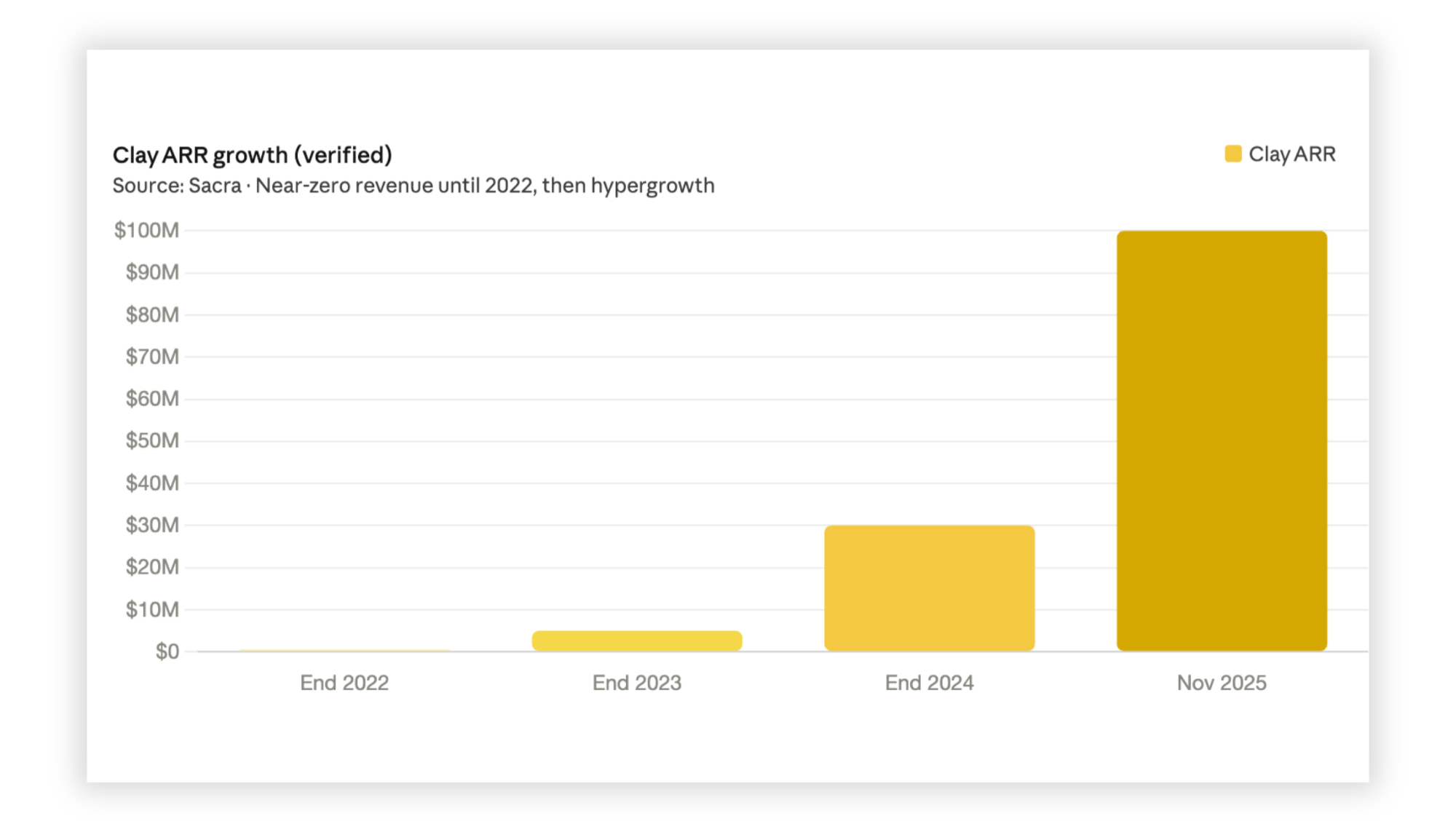
Clay's growth is characterized as hypergrowth — 10x revenue increases in 2022 and 2023, followed by a 6x surge in 2024, reaching $100M ARR by the end of 2025 and a $3.1B valuation backed by Sequoia and CapitalG. Its customer base includes Anthropic, OpenAI, Canva, Ramp, and Rippling, and Clay has emerged as the dominant platform in GTM engineering — the most frequently required tool among companies hiring for the role. The growth reflects a broader shift: 60%+ of companies now adopt AI-powered data enrichment with clear ROI, and GTM teams are consolidating around orchestration layers that connect enrichment, sequencing, and CRM in one workflow. For Pubrio, being a native provider inside Clay means being part of the infrastructure that the fastest-growing GTM teams are building on — not an add-on, but a data layer inside the stack they are already running.
Watch the full integration walkthrough: Clay x Pubrio demo
The Coverage Gap No One Talks About
Mainstream B2B datasets are built from professional network data. That is a reasonable starting point for English-speaking markets with high digital adoption — the US, UK, Canada, Australia — where most companies have significant LinkedIn presences and English-language web footprints.
It stops being reasonable the moment you target anywhere else.
Southeast Asia, MENA, Japan, South Korea, Latin America — in all of these markets, a majority of companies have minimal or zero presence in the sources mainstream datasets index. They exist in local business registries, regional marketplaces, and local-language news ecosystems. A standard enrichment provider looking at those companies returns nothing. A waterfall of standard enrichment providers returns nothing, in sequence.
"By connecting Clay with Pubrio's glocalized business data layer, we went beyond the usual 30% of well-indexed companies and uncovered the real long tail across North America, EMEA, and APAC. Pubrio's local signals plugged directly into our Clay workflows, so we could build live lists of local businesses in any market without changing our existing playbooks."
— GTM engineer, revenue team using Pubrio + Clay
Pubrio addresses this architecturally. Rather than extending from a single global professional network, it aggregates from 50+ local sources in each market — country-specific registries, regional job platforms, local-language business directories — and normalizes them into a single structured global graph. When Clay queries Pubrio, it is querying that local-source layer: the companies that have never appeared in any of the other providers in the waterfall.
What Pubrio Brings to the Clay Ecosystem
APAC intelligence. Expansion signals, hiring signals, and real-time revenue data from local APAC sources — the depth that standard databases consistently cannot return for this region, now queryable directly inside Clay.
Long-tail coverage. Businesses across North America, EMEA, and APAC that do not appear in mainstream datasets appear in Pubrio's local-source graph. No tool-switching, no playbook changes — the same Clay workflow returns more complete results.
AI agent accuracy. AI agents inside Clay perform only as well as the data they consume. Pubrio's verified, locally-sourced signals eliminate the hallucinations and gaps that occur when agents are forced to work from incomplete or stale records.
Expansion Signals. Move beyond static firmographics to locally-verified, activity-based signals — hiring spikes, funding events, partnership announcements, technology adoption changes — sourced from the local ecosystems where they actually originate.
| Workflow | What it does | Best for |
|---|---|---|
| 01 · Prospect enrichment at scale | Feed raw domains into Clay. Pubrio enriches each row with verified firmographics, headcount, tech stack, and decision-maker contacts including E.164 phone numbers and LinkedIn URLs | Any team enriching lists at volume — especially with APAC or non-English accounts |
| 02 · Signal-based outreach triggering | Monitor target accounts in Clay. When Pubrio surfaces a trigger — hiring spike, funding event, technology adoption — Clay fires the next outreach step automatically | Teams running event-triggered outbound rather than cadence-based sequences |
| 03 · ICP-matched list building | Define your ICP inside Clay as a filter set: industry, headcount, geography, tech stack, growth signals. Pubrio returns a matched list from its global data layer | APAC-heavy ICPs where directory-based tools return incomplete or stale results |
| 04 · Global waterfall coverage | Use Pubrio as the glocalized layer in a Clay waterfall. Other providers fill English-market records; Pubrio fills the rest — reducing fallback triggers and per-row cost | Teams with multi-market targets wanting maximum coverage without cost inflation |
How to Set It Up in Clay
The integration is native — no custom code, no API gymnastics. Once your Pubrio and Clay accounts are connected:
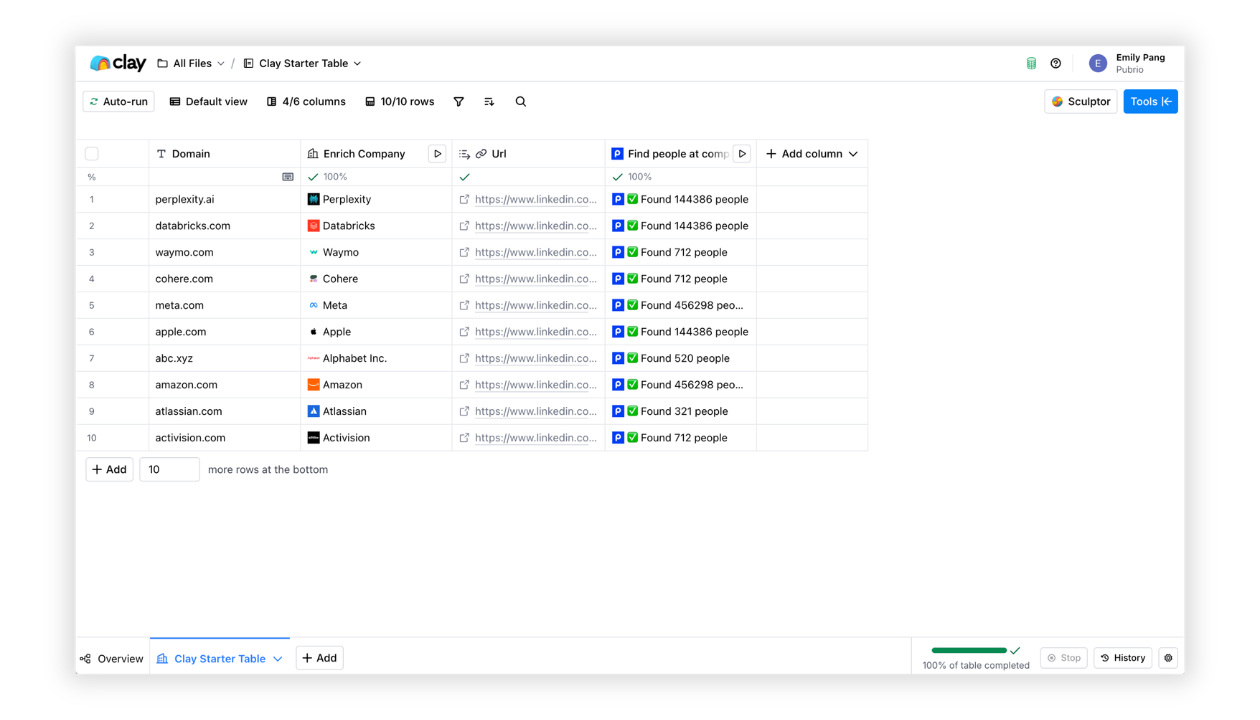
Step 1 — Add enrichment. Inside your Clay table, select Add enrichment, then search for Pubrio. Choose from the available actions — for example, Find people at company.
Step 2 — Set your input. Use either a company domain (e.g. clay.com) or a LinkedIn company profile URL as your input source.
Step 3 — Receive validated output. Instantly get LinkedIn profile URLs, professional names, and verified phone numbers in E.164 format — ready to feed directly into the next step in your workflow.
Who This Is Built For
Clay + Pubrio is the right stack for GTM builders, RevOps leads, and sales engineers running outbound with ICP discipline at volume — particularly for teams whose pipeline targets include APAC, MENA, or any market where standard enrichment providers consistently underperform.
If your team is patching together tools to cover different geographies, manually researching accounts that your enrichment stack cannot find, or running broad sequences because your data does not give you a sharper signal — this integration is a direct architectural fix for that problem.
The coverage gap is not a data quality issue. It is a source architecture issue. Pubrio brings a different source layer into Clay: the 50+ localized registries and regional platforms where the other 70% of the global market actually generates its data footprint.