How to Use Expansion Signals to Find Accounts Before They Enter Your Market
By the time a company posts a country manager role on LinkedIn, the shortlist is forming. Expansion Signals fire weeks earlier — in local registries, regional job boards, and local-language trade press. This guide covers how to detect them and what to do when they fire.


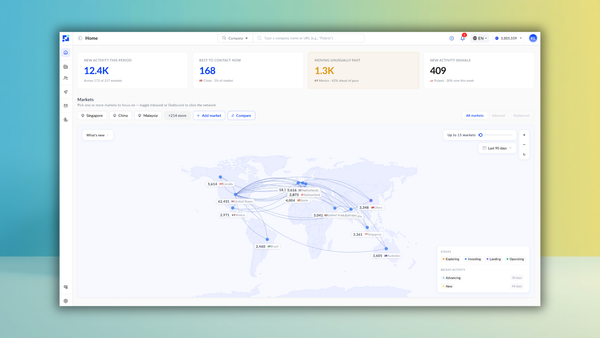
Expansion Signals are observable business events that indicate a company is moving toward or actively entering a new market — sourced from local registries, regional job platforms, and local-language trade press rather than English-language aggregators. To use them: (1) Define which signal types indicate market entry relevant to your product; (2) Set up detection for those signals across local registries and regional sources in your target markets; (3) Score signal clusters — two or three signals from the same company within 30 days is a buying window; (4) Route the account into a signal-referenced sequence immediately — the window is 2–6 weeks at Investing stage, 30–90 days at Landing stage; (5) Lead with the implication of the signal, not the signal itself. Pubrio's Expansion Signal layer generates 120,000+ daily signals across 130+ countries from these local sources — surfacing market entry events before they travel to LinkedIn or Crunchbase.
By the time an opportunity lands in your pipeline, the buying decision has already been in motion for months. Budgets were planned, funding was allocated, and vendors were quietly evaluated long before anyone filled out a form or replied to an outreach sequence.
Most B2B teams are reacting to a story already being written — reaching companies after the entity is registered, the team is hired, and the first vendor calls are done. Expansion Signals fire at the source. This guide covers how to detect them, score them, and act within the window.
Step 1 — Define which signals indicate market entry for your product
Not every expansion signal is relevant to every vendor. The first step is mapping signal types to the business events they indicate for your specific product category.
If you sell compliance or regulatory technology: The highest-value signal is a compliance hiring surge — a company posting five or more compliance, legal, or regulatory affairs roles in a new market within 30 days. This indicates a mandatory evaluation cycle is underway. The company is not considering compliance software. It is actively building the function that will select it. A second strong signal: a regulatory filing or sector licence application in the target market, visible through country-specific databases.
If you sell CRM, sales tools, or GTM software: The highest-value signal is a new VP of Sales, CRO, or country manager hire in the target market. New sales leaders evaluate inherited and newly-needed tools within 90 days of hire. A secondary signal: 10%+ headcount growth in sales and customer success roles in 90 days, visible through regional job platform posting velocity.
If you sell infrastructure, logistics, or operations technology: The highest-value signal is an entity registration in the country's official business registry. This is the point of structural commitment. The company has registered a legal entity before hiring, before leasing office space, and before any press release. Technology procurement for that entity starts within days of registration.
Step 2 — Set up detection across local sources
Standard signal tools — LinkedIn Sales Navigator, Apollo, Bombora — are built from English-language infrastructure. They surface expansion signals after those signals travel through English-language channels. A new subsidiary registered in Indonesia's AHU appears in Crunchbase weeks later, if at all. A country manager hired on a regional Southeast Asian job board never appears in a LinkedIn signal alert if the candidate did not have an active LinkedIn profile.
Local business registries — real-time entity registration monitoring across country-specific databases. A new subsidiary filing in any of these registers is a high-confidence Investing-stage signal, visible at the point of filing.
Regional job platforms — monitoring for country manager, local leadership, and market-entry role postings across the platforms where local hiring actually happens. These carry market entry hiring signals weeks before LinkedIn.
Local-language trade press — monitoring funding announcements, partnership disclosures, and expansion news in local-language financial publications. These carry signals at the point of first publication — days to weeks before English-language aggregators.
Pubrio's Expansion Signal layer monitors all three — 120,000+ daily signals across 130+ countries, routable via API into Clay, OttoKit, or your CRM without manual monitoring.
Step 3 — Score signal clusters, not individual signals
Two or three signals from the same company within 30 days is a buying window. The highest-converting clusters:
Cluster 1 — Investing stage: Entity registration + office lease + infrastructure hiring surge. Three independent sources, same commitment window. Act within 2–4 weeks.
Cluster 2 — Landing stage: Country manager hired + local partnership announced + sales team hiring begins. Vendor evaluations underway. Act within 30–60 days.
Cluster 3 — Operating upgrade: 10%+ headcount growth + compliance hiring surge + enterprise tech roles posted. Entry-level stack being replaced. Act within 60–90 days.
Accounts with two or more Tier 1 signals in 30 days route automatically to your highest-priority sequence.
Step 4 — Act within the signal window
Good signals expire in review queues. Teams triggering sequences within an hour of a signal consistently outcompete teams on weekly review cycles. Investing window: 2–4 weeks. Landing: 30–90 days. Operating upgrade: 60–90 days.
Automate the routing — when a cluster score exceeds your threshold, the account enters a sequence without a human triage step.
Step 5 — Message the implication, not the signal
Weak: "I noticed you registered an entity in Indonesia — congrats on the expansion." Strong: "Companies entering Indonesia at the Investing stage typically face [specific challenge] within 90 days. We helped [similar company] address this before their first local hire."
The signal sets the timing. The message addresses the predictable problem that stage implies. Match the channel: WhatsApp for MENA and Indonesia, Zalo for Vietnam, LINE for Thailand, formal email for Japan.
| Stage | Signal cluster | Detection source | Act within | Message angle |
|---|---|---|---|---|
| Investing | Entity registration + office lease + infrastructure hiring | Local registry at point of filing | 2–4 weeks | Predictable challenge at market entry stage |
| Landing | Country manager hired + local partnership announced + sales team hiring | Regional job platforms + local-language trade press | 30–60 days | What similar companies needed in first 90 days in this market |
| Operating | 10%+ headcount growth + compliance hiring surge + enterprise tech roles | Regional job board posting velocity + local tech press | 60–90 days | Upgrade from entry-level stack — what the scale moment requires |
| Exploring | International strategy roles + local association engagement | Regional job boards + local chamber databases | Relationship building — no pitch yet | Thought leadership in the market they are researching |
Why local-source detection matters
For North America and tier-1 Europe, LinkedIn and Apollo cover most Investing and Landing signals — with a lag. For APAC and MENA, they miss them entirely. A subsidiary registered in Indonesia's local registry does not appear in mainstream tools. Pubrio closes this gap — sourcing from 50+ local registries and regional job platforms and local-language press across 130+ countries. Connect to Clay, OttoKit, or your CRM and the five steps above apply equally to Jakarta or Riyadh.
1B+ profiles from 50+ local registries across 130+ countries. Free plan. From $99/month.
From Local Sources in 130+ Countries