How to Build a Global ICP That Works Across APAC, MENA, and Europe
A single ICP built for North America fails in Vietnam, Saudi Arabia, and Germany because company size benchmarks, procurement norms, and data infrastructure differ by market. This guide covers how to build a global ICP that actually works across APAC, MENA, and Europe.


A global ICP has two layers: a universal layer (the product fit criteria that apply regardless of geography — industry vertical, problem type, technology maturity) and a market-specific layer (the firmographic thresholds, data sources, regulatory context, and signal types that differ by region). The most common mistake is applying North American firmographic benchmarks globally — a 100-employee company in Vietnam is mid-market; in Germany it is a small business. A 50-person fintech in Singapore has a different procurement process from a 50-person fintech in Saudi Arabia. Build the universal layer first from your closed-won data. Then calibrate the market-specific layer for each region: relative company size benchmarks, local data sources for finding ICP-fit accounts, regulatory triggers that create procurement windows, and the Expansion Signals that indicate an account in your target profile is entering an active buying cycle.
Companies with a clearly defined ICP report 68% higher win rates — a figure confirmed across SiriusDecisions (now Forrester) and Gartner research. 68% of B2B companies do not have one. The gap is not a lack of frameworks — most ICP frameworks were built for North American markets and break when applied globally.
A "mid-market company with 100–500 employees" means dedicated budget holders and structured procurement in North America. The same headcount in Vietnam may describe a founder-led company with a 2-week evaluation cycle. In Germany, a Mittelstand manufacturer with a 9-month procurement process. Same filter. Three completely different buyers.
A global ICP solves this with two layers: a universal product-fit layer that applies everywhere, and a market-specific calibration layer that adjusts thresholds, data sources, and procurement characteristics per region.
Step 1 — Build the universal layer from closed-won data
Pull your top 20–30 closed-won accounts — the ones renewing without drama and expanding. Identify the patterns that cut across geographies: industry vertical, the problem they were solving at purchase, technology maturity, and the trigger that started the evaluation.
The universal layer is not firmographic — it is problem-and-trigger based. Which companies have the problem your product solves, and what event precipitates the evaluation? A company entering a new market needs compliance tools, data infrastructure, and local market intelligence regardless of whether it is entering from Singapore, Dubai, or Frankfurt. This layer travels intact across all geographies. Everything else gets calibrated per market.
Step 2 — Calibrate firmographic thresholds per market
North American company-size benchmarks do not translate globally. Apply market-relative calibration on three dimensions.
Employee count: 100 employees in Indonesia is a significant mid-market player with an independent budget. In Germany, it is an SME likely operating with a single decision-maker. In Singapore, it may be a regional HQ of a 10,000-person multinational with a structured procurement function.
Revenue thresholds: A $5M ARR company in Vietnam is high-growth and venture-backed. The same figure in the Netherlands is a stable, independently owned professional services firm. These require different messaging, different proof points, and a different sales motion — the product fit may be identical, the buyer context is not.
Company age: In Vietnam, Indonesia, and the UAE, a 3-year-old company with rapid headcount growth is often a more strategically important target than a 20-year-old stable one. In Germany and Japan, operational history and financial stability are positive indicators — not flags to deprioritise.
Anchor your global ICP to the universal trigger and problem layer, then add market-specific firmographic bands for each target region rather than applying a single global threshold.
Step 3 — Identify local data sources for each market
In North America, LinkedIn and Crunchbase cover most of the addressable market. In APAC and MENA, the majority of ICP-fit mid-market companies generate their footprint through local sources — official business registries, regional job platforms, and local-language trade press — that mainstream databases do not index.
Every country maintains a business registry listing every legally operating company, regardless of English-language digital presence. Regional job platforms surface hiring signals: who is growing, what roles they are building, which markets they are entering. Local-language trade press covers deal announcements and executive moves that never reach English-language aggregators.
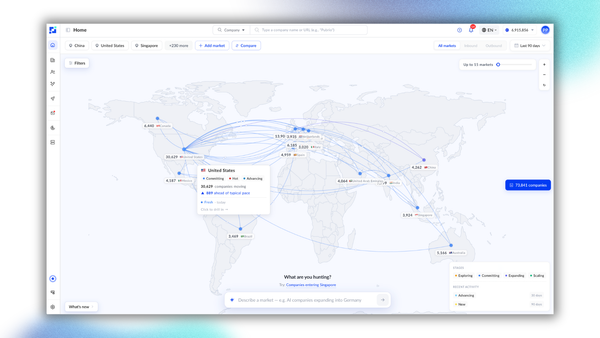
For APAC, MENA, and non-Anglophone Europe, building an ICP-matched prospect list requires sourcing from these local infrastructure layers — not applying a global database built from English-language inputs. Pubrio's data layer indexes these local sources across 220 markets, producing ICP-matched records for companies that return empty in Apollo, ZoomInfo, and LinkedIn-based tools.
Step 4 — Map procurement characteristics per market
Knowing which companies match your ICP is half the work. Knowing how they buy determines which sales motion, cycle length, and entry approach to apply — before the first outreach goes out.
Southeast Asia: Founder or C-suite led, 2–4 week cycles, single decision-maker. Relationship-first entry essential — cold outreach converts poorly without a warm introduction. Singapore is more structured, closer to ANZ and UK norms.
Japan / South Korea: Japan: 6–18 month consensus cycles, multiple sign-offs, local partner effectively required as first-touch. South Korea moves faster but hierarchy is strong — engage the senior decision-maker early.
India: Price-sensitive across most segments. Multi-stakeholder above 500 employees. Tier 1 city accounts move faster and are more familiar with international SaaS than Tier 2.
UAE / Saudi Arabia: Relationship and trust-led. Government-adjacent deals require local presence or partner. Arabic-language materials expected for enterprise. UAE is more internationally oriented — English sales motion works in Dubai.
Germany / DACH: 3–9 month cycles. Procurement committee sign-off above 200 employees. German-language materials expected. Data residency documentation required before commercial conversations in regulated sectors.
UK / Nordics: UK is the most North American-aligned in Europe — faster cycles, champion-led. Nordics are consensus-driven but execute quickly once decided.
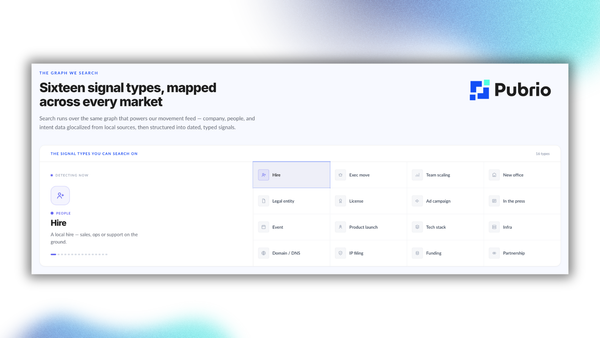
Pubrio's Expansion Signal layer surfaces ICP-fit accounts at the point of entry — entity registration, in-market hire, or partnership announcement — before procurement processes start.
Step 5 — Score and refresh quarterly
A scored ICP converts a qualitative profile into a prioritisation tool. ICP-fit accounts close at 68% vs 22% for non-fit accounts, with sales cycles 20–30% shorter — Cleanlist, 2026. Teams with a documented, scored ICP report 20–40% higher win rates and 15–30% shorter sales cycles vs. teams running without one. For global programmes, geography should be a modifier — not a primary filter. An ICP-fit account in Indonesia scores the same as one in Germany if it matches on industry, problem, and trigger. The market-specific calibration in Steps 2–4 handles the threshold differences; the scoring model stays universal.
Weight six attributes, with firmographic fit lowest given its market-sensitivity:
| Attribute | Weight |
|---|---|
| Industry vertical fit | 25% |
| Problem/trigger match | 25% |
| Technology maturity | 20% |
| Buying signal present | 20% |
| Firmographic fit (market-adjusted) | 10% |
Accounts scoring 70+ route to active outreach. Accounts scoring 50–70 enter a signal-monitoring queue — they match the profile but have not yet shown a trigger. Accounts below 50 are deprioritized regardless of how large or well-known they appear.
Refresh the market-specific calibration quarterly. High-growth markets like Vietnam, Indonesia, and UAE shift materially year over year — company-size thresholds, procurement norms, and technology adoption baselines all change faster than in mature markets. Each refresh should be anchored to your closed-won data from that period, not just analyst reports. Quarterly ICP reviews are now standard practice for top-performing B2B revenue organisations. High-growth markets like Vietnam, Indonesia, and UAE change faster than mature markets — company-size thresholds, procurement norms, and technology adoption baselines shift materially year over year.
| Region | Size calibration | Primary data source | Procurement characteristics |
|---|---|---|---|
| Southeast Asia | 50–200 employees = mid-market; growth rate more predictive than headcount | Local business registries + regional job platforms | Founder or C-suite as sole decision-maker; 2–4 week cycles; relationship-first entry essential |
| Japan / Korea | 100–500 employees; company age and stability positive indicators | Local business registries + regional job platforms | Consensus-driven; 6–18 month cycles; local partner or referral required as first-touch in Japan |
| India | 200–2,000 employees; Tier 1 cities differ materially from Tier 2 | Local business registries + regional job platforms | Price-sensitive; multi-stakeholder above 500 employees; Tier 1 city accounts move faster than Tier 2 |
| UAE / Saudi | 100–500 employees for tech; larger for government-adjacent sectors | Local business registries + regional job platforms | Relationship and trust-led; government-adjacent deals require local presence; Arabic-language materials expected |
| Germany / DACH | 50–500 employees (Mittelstand); stable, conservative procurement cycles | Local business registries + trade press | Conservative; 3–9 month cycles; procurement committee sign-off common; German-language materials expected |
| UK / Nordics | 50–500 employees; UK most North American-aligned in Europe | Local business registries + trade press | UK most North American-aligned; Nordics consensus-driven with fast execution once approved |
Using Pubrio to activate a global ICP
Pubrio sources from local registries, regional job platforms, and local-language trade press across 200+ markets — returning verified ICP-matched records for companies invisible to English-language databases. The Expansion Signal layer adds the trigger: when an ICP-fit account shows an entity registration, in-market hire, or expansion signal, Pubrio surfaces it as a dated, typed signal confirming both fit and buying cycle.
800M+ companies. 50+ local data sources. Daily refresh. From $125/month.
Across 200+ Markets