How to Find Decision-Makers in APAC Without LinkedIn
LinkedIn penetration in Vietnam, Indonesia, and Thailand is a fraction of Singapore's. Most mid-market APAC decision-makers don't maintain meaningful LinkedIn profiles. This guide covers 6 methods to find them — from local registries to regional job platforms to local-language trade press.


Six methods that work: (1) Local business registries — AHU (Indonesia), SSM (Malaysia), ACRA (Singapore), DBD (Thailand), DART (South Korea), NTA (Japan) list directors and registered officers by company; (2) Regional job platforms — the decision-maker hiring the role is often identifiable from the job posting itself; (3) Local-language trade press — executives named in deal and partnership announcements; (4) Industry associations and chamber membership directories — especially powerful in Japan and South Korea; (5) Company websites in local language — "About Us" and leadership pages in Vietnamese, Bahasa Indonesia, or Thai often name contacts absent from LinkedIn; (6) Local-source data platforms like Pubrio — which index all of the above and return verified contacts for mid-market APAC companies that do not appear in Apollo, ZoomInfo, or LinkedIn-based tools.
LinkedIn has 323 million members in APAC — yet Southeast Asia accounts for only 6.9% of global LinkedIn membership. Singapore has approximately 50% LinkedIn population penetration. Vietnam, Indonesia, and Thailand are a fraction of that.
The consequence: a sales team targeting mid-market manufacturers in Vietnam, logistics firms in Indonesia, or healthcare companies in Thailand with a LinkedIn-first prospecting workflow is working from a list that misses the majority of its addressable market. The decision-makers exist. They are just not on LinkedIn — or they have bare-bones profiles that tell you nothing useful.
Six methods find them where they actually are.
Method 1 — Local business registries
Every APAC country maintains an official business registry that lists company directors, registered officers, and in some cases shareholders. These are legal documents — the names are verified, current, and authoritative. For many mid-market APAC companies, the registry is the only publicly available source for decision-maker identity.
By market:
- Indonesia: AHU (Administrasi Hukum Umum) — lists directors (Direktur) and commissioners for every PT company
- Malaysia: SSM (Suruhanjaya Syarikat Malaysia) — lists directors for Sdn Bhd and Bhd entities
- Singapore: ACRA — lists directors and shareholders for all registered companies
- Thailand: DBD (Department of Business Development) — lists juristic persons and authorized directors
- South Korea: DART — financial disclosures name executives and board members
- Japan: NTA Corporate Number database — combined with company registry filings for director information
- India: MCA (Ministry of Corporate Affairs) — lists directors for all registered companies
From the registry, you get the name. From there: cross-reference the company website (often in local language), local-language trade press, and regional job platform postings to find contact details or infer the email format.
Method 2 — Regional job platforms
The decision-maker is often identifiable from the job posting they approve or that reports to them. A company posting "VP of Sales — report to COO" on Naukri (India) tells you the COO exists and is active. A company posting "Compliance Manager — report to CFO" on Kalibrr (Philippines) tells you who owns the compliance budget.
Key platforms by market:
- India: Naukri, TimesJobs (70M+ registered jobseekers on Naukri alone)
- Indonesia: Kalibrr, Glints, JobStreet
- Vietnam: Vietnamworks, TopCV
- Thailand: JobsDB, JobThai
- South Korea: JobKorea, Saramin
- Japan: Rikunabi, Mynavi, Doda
- Taiwan: 104 Job Bank
- MENA: Bayt, GulfTalent
Beyond identifying seniority levels, job postings reveal the technology stack a company uses, the team structure, and often the direct hiring manager's name in the "who you'll work with" section. This is contact intelligence that English-language databases cannot produce for these markets.
Method 3 — Local-language trade press
Partnership announcements, executive interviews, and deal closures in APAC markets are covered first in local-language trade press — before they reach LinkedIn, Crunchbase, or English-language business media.
By market:
- Vietnam: Nhip Cau Dau Tu, VnExpress Business, CafeF — name executives by title in deal coverage
- Indonesia: Kontan, Bisnis Indonesia — executive interviews and partnership announcements with full names
- Thailand: Krungthep Turakij, Prachachat Turakij — business news covering mid-market and enterprise deals
- South Korea: The Bell, Hankyung — covers tech and finance executive movements
- Japan: Nikkei Business, Diamond Online — executive profiles and deal coverage
- India: The Ken, VCCircle, Entrackr — covers funded company executives by name
A Google search in the local language — "ประธาน [company name] Thailand" or "direktur [company name] Indonesia" — frequently surfaces executive names in local press that do not appear in any English-language tool. This method is manual but produces contacts for companies that are completely invisible to standard databases.
Method 4 — Industry associations and chamber directories
Japan, South Korea, Singapore, and Taiwan have active industry associations and chambers of commerce that publish member directories — often including company name, representative name, and contact details. These are authoritative, current, and entirely outside LinkedIn's coverage.
High-value examples:
- Japan: JETRO (Japan External Trade Organization) — member directories by industry; Tokyo Chamber of Commerce
- South Korea: KITA (Korea International Trade Association) — lists company representatives by sector
- Singapore: Singapore Business Federation, Singapore Chamber of Commerce — member directories
- Taiwan: TEEMA (Taiwan Electrical and Electronic Manufacturers' Association) — sector-specific contacts
- India: CII (Confederation of Indian Industry), NASSCOM — technology sector membership lists
For enterprise accounts in Japan especially, where nemawashi means the key stakeholders are often not the publicly visible executives, association membership gives you a different entry point — the industry-facing representative who manages external relationships.
Method 5 — Company websites in local language
This one is underused and consistently productive. The same company that has a bare English-language LinkedIn profile or a sparse Crunchbase entry often has a detailed local-language website with a full "About Us" page, leadership team photos, and named executives.
Search the company name in the local language through Google, adding "leadership," "management," or "director" in the local language. For Indonesia: "[company name] direksi" or "[company name] manajemen." For Vietnam: "[company name] ban lãnh đạo." For Thailand: "[company name] ผู้บริหาร."
The local-language version of a company's digital presence is almost always more informative than the English-language version for mid-market APAC companies. The decision-maker names you find here are often absent from every English-language data tool.
Method 6 — Local-source data platforms
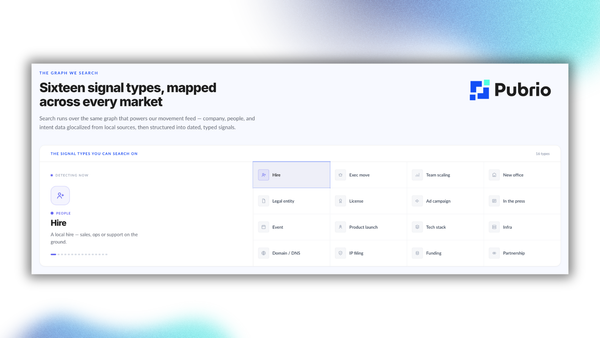
The five methods above are manual. For teams building APAC prospect lists at scale, Pubrio systematically indexes all of them — local business registries, regional job platforms, local-language trade press, and company website data — across 130+ countries.
When you search for a mid-market logistics company in Indonesia in Pubrio, the contact record draws from local business registries, regional job platforms, local-language trade press, and company website data — not from LinkedIn or English-language web crawls. The result is a verified decision-maker contact for a company that returns empty in Apollo, ZoomInfo, and every LinkedIn-based tool.
1B+ profiles from 50+ local registries and regional sources across 130+ countries. The Expansion Signal layer surfaces 120,000+ daily buying indicators from these same local sources — so you know not just who the decision-maker is, but when they are in an active buying cycle. Free plan. From $125/month.
| Market | Registry source | Job platform | Local trade press |
|---|---|---|---|
| Indonesia | AHU — directors by PT | Kalibrr, Glints | Kontan, Bisnis Indonesia |
| Vietnam | National Business Registration Portal | Vietnamworks, TopCV | Nhip Cau Dau Tu, CafeF |
| Thailand | DBD — juristic persons | JobsDB, JobThai | Krungthep Turakij |
| South Korea | DART — financial disclosures | JobKorea, Saramin | The Bell, Hankyung |
| Japan | NTA Corporate Number | Rikunabi, Mynavi | Nikkei Business |
| India | MCA — company directors | Naukri, TimesJobs | The Ken, VCCircle |
| Singapore | ACRA — directors and shareholders | LinkedIn, MyCareersFuture | Business Times, CNA Business |
Local Sources in 130+ Countries