
The Exploring Stage Trap: Why 60% of Expansion Signals Get Ignored (And How to Fix It)
Most revenue teams only act on Expanding and Scaling signals — entity filings, exec hires, office openings. They ignore Exploring signals entirely. That is where the shortlist forms. By the time the entity is filed, 85% of vendor decisions are already made.


Three reasons. First, most signal-based selling frameworks are built around high-confidence triggers — entity filings, exec hires, funding announcements. Exploring signals (geo-targeted ads, conference attendance, news mentions) look soft by comparison and get deprioritised. Second, CRM qualification logic requires a concrete opportunity — "a company running ads in Vietnam" does not map to a deal stage. Third, Exploring signals require a different outreach motion (relationship-building, not pitching) that most teams do not have a playbook for. The cost of this blind spot: 85% of B2B purchases go to a vendor already on the day-one shortlist (Corporate Visions). The shortlist forms at Exploring stage — before any entity is filed, any exec is hired, or any office is announced. Teams that only act on Expanding signals are competing for a shortlist that was already written.
The trap
Most revenue teams have a signal-based selling motion built around confidence. A legal entity filing is high-confidence. An exec hire is high-confidence. A funding announcement is high-confidence. These signals fire at Expanding or Scaling stage — when the company has made a legally binding commitment to a new market and procurement decisions are underway.
The problem: 85% of B2B purchases go to a vendor already on the buyer's day-one shortlist. That shortlist does not form when the entity is filed. It forms weeks or months earlier — when the company is researching markets, attending regional conferences, running geo-targeted ads, and reading local trade press. Exploring stage.
60% of the B2B buying journey completes before a buyer contacts any vendor. By the time a company registers a local entity in a new market, they have already researched the vendor landscape, shortlisted 3–5 options, and begun internal conversations about who to evaluate. The vendor who shows up with a cold outreach sequence the week the entity is filed is not early. They are late.
Exploring stage signals are the window before the shortlist forms. Most teams ignore them entirely.
Why teams skip Exploring signals
They look soft. A geo-targeted ad campaign does not feel like a buying signal. A conference sponsorship feels like marketing activity, not a procurement trigger. Revenue teams trained on high-confidence triggers — entity filings, exec hires, funding rounds — look at Exploring signals and see noise.
They are not noise. They are the earliest verifiable evidence that a company is evaluating a new market — before any commitment is made, before any procurement process has started, and before any competitor has a relationship in place.
CRM logic does not accommodate them. Opportunity stages require a contact, a company, a deal value, and a probability. "Company X ran geo-targeted ads in Vietnam this week" does not fit a deal stage. So the signal gets filed nowhere, actioned by nobody, and expires without a single touch.
There is no Exploring-stage playbook. Most outbound sequences are built for companies already in a buying cycle — they lead with a pitch, a demo offer, or a pain-point message. At Exploring stage, the company is not yet in a procurement cycle. A pitch sequence sent to a company still deciding whether to enter a market will get ignored. The right motion is different: visibility, insight, and soft positioning — not a sequence.
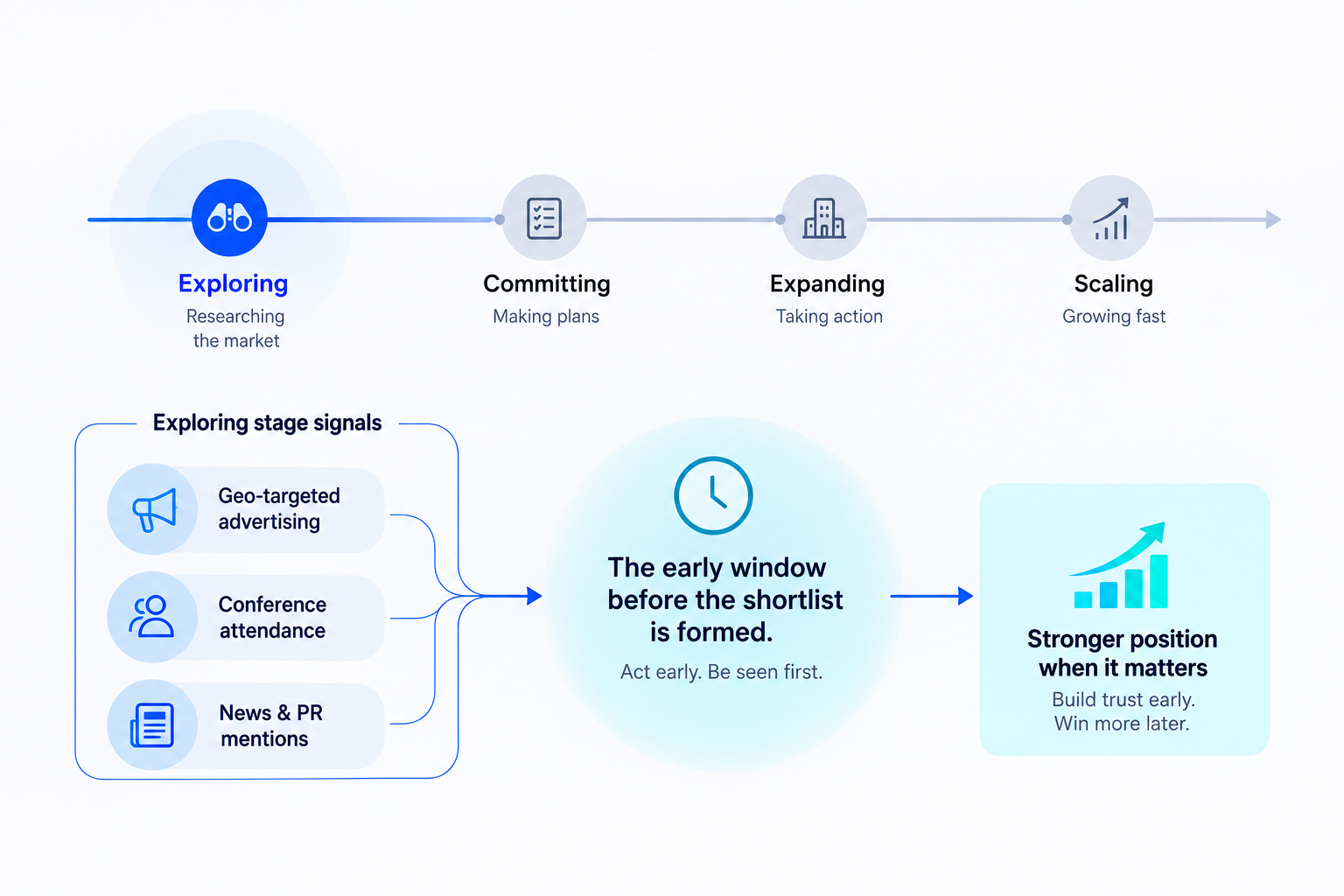
What Exploring stage signals look like in practice
Pubrio tracks three signal types at Exploring stage:
Geo-targeted advertising — paid digital ads running in a market where the company has no operational presence. Demand validation: testing whether a buyer exists before committing to entry. Procurement window is 3–12 months out, but the relationship window opens now.
Conference attendance — executives attending or speaking at regional trade events or government investment forums. The company is meeting local players and evaluating the landscape. The vendor who reaches out with context about that event has a structural advantage over one who waits for an entity filing.
News and PR — press coverage mentioning a new geography in the context of growth plans or executive commentary. A CEO interview referencing Southeast Asia expansion fires months before any Expanding-stage event.
None of these tell you the company is buying. They tell you it is exploring — and that you have a window to get on the mental shortlist before any formal evaluation starts.
The Exploring stage playbook
The outreach motion for Exploring stage is fundamentally different from Expanding or Scaling.
At Expanding stage (entity filed, exec hired, office opened): lead with specificity, reference the signal directly, pitch with urgency. Window is 2–6 weeks.
At Exploring stage (geo-targeted ad, conference, press mention): do not pitch. The company is gathering information, not evaluating vendors. Position yourself as a resource — share a market insight, reference the signal, invite a conversation without an agenda.
Three approaches that work at Exploring stage:
1. Market intelligence outreach. Reference the Exploring signal explicitly and offer something of value in return for a conversation. "We saw you're looking at the Vietnam market — we work with several companies entering that market and have some useful data on local buyer behaviour. Happy to share if it would be useful." No demo. No pitch. Just relevant context.
2. Event presence. If the signal is a conference attendance, be at the same event. Meet in person. A relationship started face-to-face at a regional trade event, months before any procurement cycle, converts at a fundamentally different rate than a cold email sequence sent when the entity is filed.
3. Content visibility. Ensure your content appears in the research path of a company evaluating entry into your market. A company researching Vietnam market entry should find Pubrio's content on B2B data coverage for Vietnam — not as an ad, but as a useful resource that establishes credibility before any sales conversation.
74% of B2B deals go to the vendor who helps frame the problem first. At Exploring stage, the problem is being defined. The vendor who helps a company think through market entry — before the entity is filed, the exec is hired, or the budget is allocated — is not selling. They are advising. That is a structurally better position than any competitor responding to the same Expanding-stage signal two months later.
How to operationalise Exploring stage signals
The operational challenge is real: Exploring signals are low-confidence individually and require a different process from high-confidence Expanding signals. Here is how to build it without creating noise.
Separate the queue. Exploring-stage accounts should not sit in the same pipeline queue as Expanding-stage accounts. Create a distinct signal-monitoring track: accounts in the Exploring-stage queue get relationship-building touches, not a standard outbound sequence. Route them to senior AEs or founder-level outreach where possible — the relationship-first motion requires seniority.
Set a signal cluster threshold. A single geo-targeted ad is a weak signal. Two Exploring signals (ad campaign + conference attendance) in the same market within 30 days is a strong one. A company showing geo-targeted ads in Vietnam, an exec speaking at a Southeast Asia trade event, and a press mention of regional expansion ambitions — all within 60 days — is at a very different point of commitment from a company that ran a single campaign test. Set a minimum cluster threshold (2+ signals, same market, within 60 days) before routing to active outreach.
Track the transition. An account that moves from Exploring to Committing (domain registration, local partnership, product localisation) in your target market is the highest-priority signal cluster in your entire pipeline. It confirms the market decision has been made — and you have a relationship in place. 35–50% of sales go to the first vendor to respond — having already had a relationship-building conversation at Exploring stage puts you in first-responder position by default.
Pubrio surfaces all three Exploring-stage signal types — geo-targeted advertising, conference attendance, and news/PR coverage — dated and sourced, for 800M+ companies across 200+ markets. When a company transitions from Exploring to Committing, the signal cluster updates automatically. Revenue teams see the full arc: when the exploration started, which markets are being evaluated, and when the commitment threshold is crossed — so they know exactly when to shift from relationship-building to active pipeline motion.
| Dimension | Exploring stage | Expanding stage |
|---|---|---|
| Signal examples | Geo-targeted ads, conference attendance, press mention | Legal entity filing, office lease, exec hire |
| Commitment level | No binding commitment — market is being evaluated | Legal and capital commitment made — procurement underway |
| Shortlist status | Forming now — this is when to get on it | Already set — you are competing for the remaining slots |
| Right outreach motion | Market intelligence, event presence, content visibility — no pitch | Direct pitch, specific value proposition, time-bounded offer |
| Procurement window | 3–12 months to entry decision — relationship window is long | 2–6 weeks — act immediately |
| Competition level | Low — most teams ignore Exploring signals entirely | High — every signal-aware team is targeting the same entity filing |
From Exploring to Scaling