
Expansion Signals vs. Intent Signals: When to Use Each (And Why Most Teams Mix Them Up)
Intent signals tell you who is researching your category. Expansion Signals tell you who is entering a new market. These are different questions — and mixing them up produces the wrong outreach at the wrong time. This is the clearest breakdown of when to use each.


Intent signals track anonymous research behaviour — which companies are consuming content about topics related to your category across publisher networks. They answer: Is this company researching solutions like mine? They are inferred from digital body language and are available to every subscriber of the same intent data vendor simultaneously.
Expansion Signals are verifiable business events — entity registrations, executive hires, partnership announcements, geo-targeted advertising, local press coverage — sourced from local registries, regional job platforms, and local-language trade press. They answer: Is this company committing to a new market where they will need solutions like mine across 10–15 vendor categories simultaneously?
The two are complementary, not competing. Intent signals identify who is researching your category right now. Expansion Signals identify who is entering a buying cycle driven by market expansion — often before any intent signal fires, in markets where intent data has no coverage at all.
Why teams mix them up
Both intent signals and Expansion Signals are used to prioritise outreach. Both appear in the same signal-based selling conversation. Both get lumped into the same "data enrichment" budget line. But they answer fundamentally different questions — and using one where the other is needed produces the wrong outreach at the wrong time.
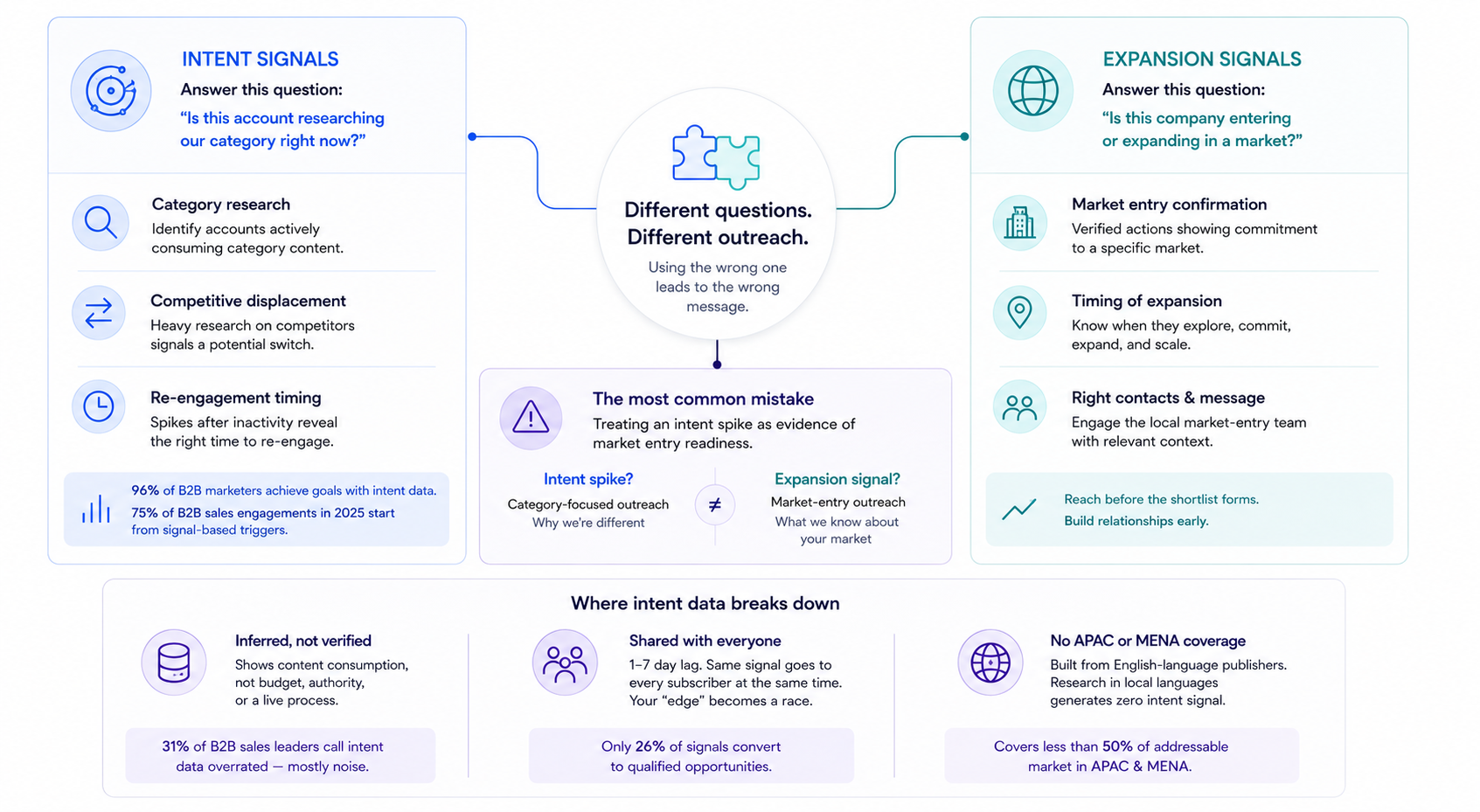
The most common mistake: treating an intent spike as evidence of market entry readiness. An intent spike warrants category-focused outreach: "We saw you've been researching this space — here's why we're different." An Expansion Signal warrants market-entry outreach: "We saw you registered an entity in Vietnam — here's what we know about that market specifically." Different data, different message, different person in the organisation. Mixing them up means sending the wrong one.
What intent signals actually do well
Intent data has a clear, well-documented use case: identifying accounts that are actively researching your category right now, so you can engage them while the evaluation is in progress rather than after the shortlist has formed.
96% of B2B marketers report achieving their goals with intent data, and 75% of B2B sales engagements in 2025 originated from signal-based triggers — a structural shift in how outbound works. For teams targeting English-language markets (North America, UK, Australia), intent data from established providers covers the majority of the addressable market and produces a reliable prioritisation signal for in-market accounts.
The three things intent data does well:
Category research identification. An account consuming five pieces of content about your category over 14 days is likely in-market. Intent data surfaces this before any website visit or form fill.
Competitive displacement. Heavy research into a competitor's category, especially combined with pricing page activity, indicates a potential switch. Intent data is the most reliable signal for this play.
Re-engagement timing. Accounts that went dark and are now spiking on intent are strong re-engagement candidates — a timing signal most CRMs cannot produce.
Where intent data breaks down
87% of organizations say their marketing investments produce signals that look like buying intent but do not reflect it — and only 26% of those signals convert to qualified opportunities. The problem is structural, not operational.
It is inferred, not verified. An intent spike means someone at a company consumed content on a topic. It does not mean they have budget, authority, or a live procurement process. 31% of B2B sales leaders now call intent data overrated, describing it as mostly noise. A company can spike on "market entry software" because an intern was researching the category for a presentation — not because a VP is about to sign a contract.
It is shared. Every subscriber to the same intent data co-op receives the same signal at the same time. Intent data has a 1–7 day lag between behaviour and delivery. If five vendors are subscribed to Bombora and one account spikes on your category, all five vendors will send that account a cold email in the same week. The signal that was supposed to give you an edge becomes a simultaneous race to the inbox.
It has no APAC or MENA coverage. Intent data co-ops are built from English-language publisher networks. Research behaviour in Vietnamese, Bahasa Indonesia, Arabic, or Korean generates zero signal in Bombora, 6sense, or any mainstream intent platform. For teams targeting APAC and MENA, intent data covers less than half of the addressable market by geography — regardless of the subscription tier.
What Expansion Signals do that intent data cannot
Expansion Signals answer a different question: not "is this company researching my category" but "is this company making a market entry decision that creates buying needs across 10–15 vendor categories simultaneously."
They are verifiable. A legal entity filed in Indonesia's official business registry is a legal commitment — it cannot be an intern's research project. A country manager hired on a regional job platform is a real hire that appeared in a real database. An office lease signed in Riyadh is a capital commitment. Expansion Signals are sourced from primary records, not inferred from content consumption.
They are exclusive. A legal entity filing appears in the registry the day it is filed. It reaches Crunchbase days to weeks later — if at all. A country manager hired on a regional job platform appears there before LinkedIn. A partnership announced in Vietnamese financial press appears days before English-language aggregators carry it. Expansion Signals sourced from local infrastructure arrive before the competitors monitoring English-language channels see them.
They cover markets intent data cannot. Pubrio's Expansion Signal layer sources from 50+ local registries, regional job platforms, and local-language trade press across 220 markets. The mid-market manufacturer in Vietnam, the fintech in Saudi Arabia, the logistics company in Indonesia — these companies generate no intent signal in any English-language co-op. Their expansion activity appears in local sources that Pubrio monitors in real time.
They create multi-category procurement windows. A single market entry creates buying needs across 10–15 vendor categories simultaneously. An intent spike on "payroll software" identifies one account with one potential procurement. A legal entity filing identifies one account with 10–15 open procurement decisions — compliance tools, HR infrastructure, data providers, CRM instances, financial services, and more. The procurement surface is an order of magnitude larger.
When to use each — and how to stack them
The highest-performing signal stacks in B2B use both — but for different purposes at different stages of the account journey.
Use intent signals for: in-category prioritisation within your ICP list, competitive displacement plays in English-language markets, and re-engagement timing for accounts that have gone dark.
Use Expansion Signals for: new account discovery in markets where intent data has no coverage, first-mover outreach in the 2–6 week window after market entry commitment (entity filing, exec hire, office lease), relationship-building at Exploring stage before any intent signal fires, and multi-category plays where one account has simultaneous procurement needs across 10–15 vendor categories.
Stack them for the highest conversion rate. Programs combining multiple account signals generate 2.6x more pipeline per marketing dollar with 41% higher win rates vs. broad-reach demand generation. An account showing an Expansion Signal cluster (entity + exec hire) AND an intent spike on your category is the highest-priority account in your pipeline — market entry confirmed, active research confirmed, procurement window open.
How Pubrio fits
Pubrio provides the Expansion Signal layer: 16 signal types across four expansion stages — Exploring, Committing, Expanding, Scaling — sourced from local registries, regional job platforms, and local-language trade press across 200+ markets. 800M+ companies, 50+ local sources, daily refresh.
For teams already using intent data, Pubrio is the layer that covers what intent data cannot: verifiable market entry events, APAC and MENA local sources, and the pre-intent signal window where the vendor shortlist forms. The two work alongside each other — intent data tells you who is researching your category in English-language markets; Expansion Signals tell you who is entering a buying cycle in every market, verified from local sources, before the intent signal fires.
| Dimension | Intent signals | Expansion Signals (Pubrio) |
|---|---|---|
| Question answered | Is this company researching my category? | Is this company entering a new market — creating 10–15 simultaneous vendor needs? |
| Signal basis | Anonymous content consumption across publisher co-ops — inferred, not verified | Verifiable business events — legal filings, job postings, local press — cross-referenceable against primary sources |
| Source | English-language publisher networks (Bombora, G2, TechTarget, Demandbase) | Local registries, regional job platforms, local-language trade press — 50+ sources, 220 markets |
| Global coverage | English-language markets only — zero coverage for APAC and MENA local research behaviour | 220 markets including APAC, MENA, and non-Anglophone Europe — sourced locally in each market |
| Competitive exclusivity | Shared with all co-op subscribers simultaneously — 1–7 day lag | Local-source signals surface before national platforms carry them — days to weeks ahead |
| Procurement surface | One category — the account is researching one solution type | 10–15 vendor categories open simultaneously on market entry |
| Best use case | In-category prioritisation, competitive displacement, re-engagement timing | New account discovery, first-mover outreach, APAC/MENA coverage, multi-category plays |
Intent Data Cannot Cover