
The Best Way to Build a B2B Prospect List in APAC: A Step-by-Step Guide
Building a B2B prospect list in APAC is not the same as North America. LinkedIn penetration varies dramatically by market. Most mid-market companies never appear in standard databases. This step-by-step guide covers how to build an accurate APAC prospect list.


Most B2B teams treat APAC as a single market. It is not.
Singapore has approximately 50% LinkedIn penetration — one of the highest in Asia, comparable to leading Western markets. But Vietnam, Indonesia, and Thailand have far lower adoption among mid-market companies. Japan and South Korea have strong professional networks, but the dominant platforms are not LinkedIn — they are Line Works, KakaoTalk, and domestic platforms that no English-language database indexes. Southeast Asia accounts for only 6.9% of global LinkedIn members, meaning the majority of mid-market companies across the region do not maintain LinkedIn profiles meaningful enough for sales prospecting.
APAC is not a market. It is fifteen markets with fifteen different data infrastructures, fifteen different outreach norms, and fifteen different regulatory environments. A prospect list built from LinkedIn and Crunchbase works well for Singapore-headquartered tech companies. It underperforms everywhere else.
Three patterns account for most APAC prospecting failures: using a single data source for all sub-regions; applying North American outreach templates without channel adaptation; and treating the list as static when high-growth APAC markets have faster job mobility than mature Western ones.
How to build a B2B prospect list in APAC: six steps
Step 1 — Define your ICP by sub-region, not "APAC"
The first and most common error: treating APAC as a single ICP segment. Segment by geography, company size appropriate to each market's scale, industry vertical, and technology stack. A 50-person company in Singapore is mid-market. A 50-person company in Vietnam may be one of the largest independent software vendors in the country. ICP thresholds need market-relative benchmarks — not US benchmarks applied globally.
For high-growth markets like Vietnam, Indonesia, and the Philippines, also consider company age: many of the highest-growth targets are 2–5 years old and will not appear in databases that rely on historical depth. A company registered in Indonesia's AHU registry in 2023 with 150 employees and rapid headcount growth is often a more compelling target than a long-established company with a static profile.
Step 2 — Source company data from local registries
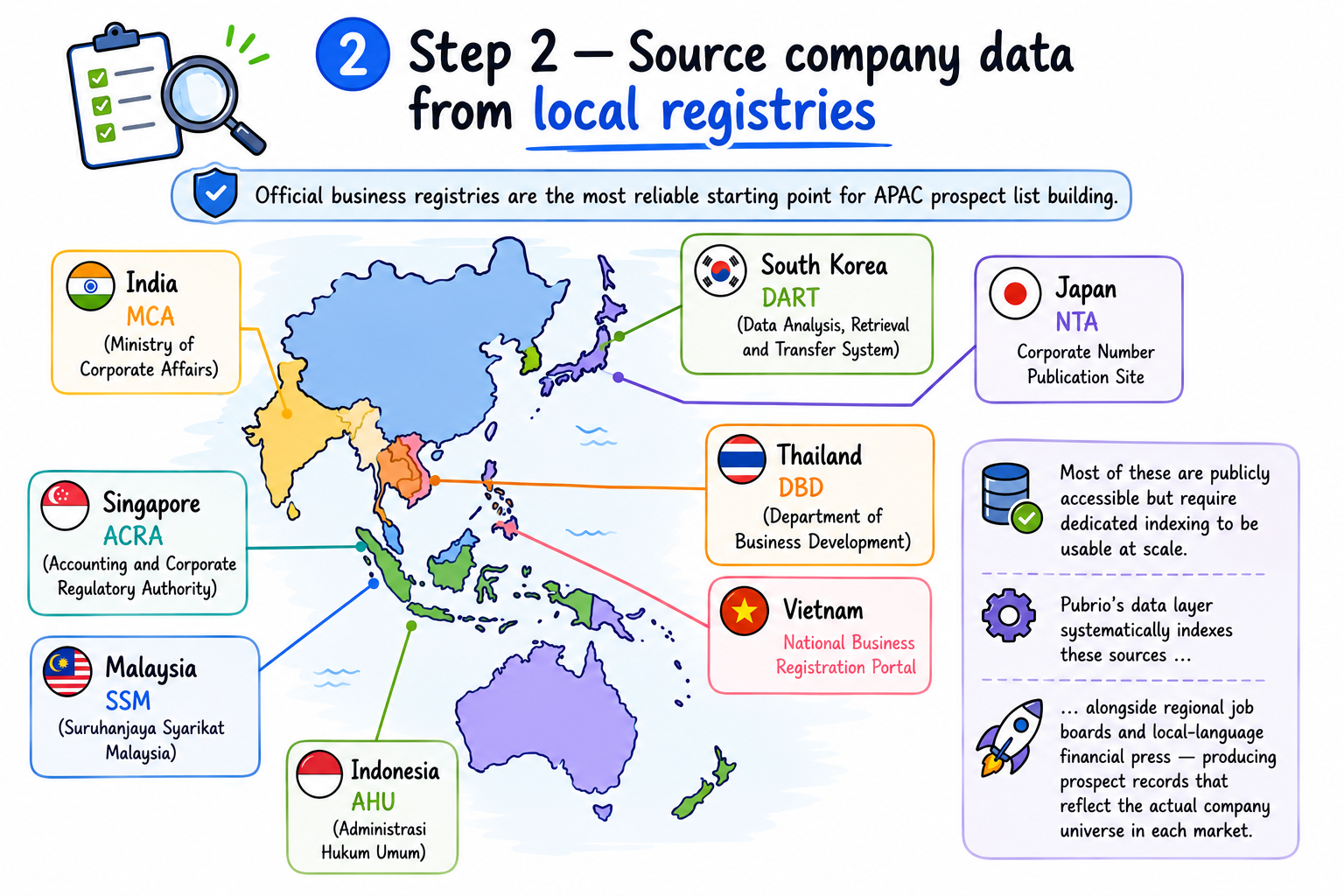
For APAC prospect list building, official business registries are the most reliable starting point. They contain every legally operating company in each jurisdiction, regardless of whether the company maintains an English-language web presence or LinkedIn profile. Key registries by market:
- Singapore: ACRA (Accounting and Corporate Regulatory Authority)
- Malaysia: SSM (Suruhanjaya Syarikat Malaysia)
- Indonesia: AHU (Administrasi Hukum Umum)
- Thailand: DBD (Department of Business Development)
- Vietnam: National Business Registration Portal
- South Korea: DART (Data Analysis, Retrieval and Transfer System)
- Japan: NTA Corporate Number Publication Site
- India: MCA (Ministry of Corporate Affairs)
Most of these are publicly accessible but require dedicated indexing to be usable at scale. Pubrio's data layer systematically indexes these sources — alongside regional job boards and local-language financial press — producing prospect records that reflect the actual company universe in each market.
Step 3 — Enrich with local hiring and signal data
Once you have a company universe, the next step is identifying which accounts are in active buying cycles. In APAC, this means monitoring local platforms that English-language tools do not capture.
By market for hiring signals: JobsDB and JobStreet for Southeast Asia; Naukri for India (70M+ registered jobseekers); Rikunabi and Mynavi for Japan; JobKorea and Saramin for South Korea; Vietnamworks and TopCV for Vietnam; Kalibrr for the Philippines.
For expansion signals: DealStreetAsia and KrASIA cover regional funding and M&A. Local-language trade publications carry announcements days to weeks before they appear in Crunchbase or PR Newswire. Pubrio's Expansion Signal layer automates this — generating 120,000+ daily buying indicators from local ecosystems across 130+ countries.
Step 4 — Verify contacts before outreach
APAC contact data decays faster than in mature Western markets due to higher job mobility in high-growth economies. Before running any outreach sequence, verify exported email addresses through a third-party tool like NeverBounce or ZeroBounce. Aim for under 5% bounce rate — anything higher risks sender domain damage. For phone-based outreach in markets where mobile contact is the primary channel, verify numbers against published company directories where accessible.
Step 5 — Adapt outreach channel by market
Building the list is half the problem. Reaching people through the right channel is the other half. APAC prospects answer phones and WhatsApp at approximately 3x the rate they respond to cold email in India, Indonesia, and MENA. Zalo is Vietnam's dominant messaging platform with 78 million monthly active users and 85% usage rate — outreach via Zalo OA meaningfully outperforms cold email for Vietnamese B2B contacts. LINE dominates Thailand. KakaoTalk is essential for South Korea.
Southeast Asian professionals show 22% higher engagement with native language content. For Vietnam, Indonesia, and Thailand, localising even just the greeting and opening context — not necessarily the full email body — meaningfully improves response rates.
Email and LinkedIn remain effective for Singapore, Australia, New Zealand, and Japanese enterprise (where formal written communication is culturally expected).
Step 6 — Set a refresh cadence
A static APAC prospect list degrades faster than a North American one. Quarterly refresh for Vietnam, Indonesia, the Philippines, and India. Semi-annual for Singapore, Australia, and Japan. More importantly: trigger re-enrichment whenever an account shows a new buying signal — a hiring surge, funding event, or registry filing is more reliable than a calendar schedule.
| Market | Primary registry | Local job platforms | Best outreach channel |
|---|---|---|---|
| Singapore | ACRA | LinkedIn, JobsDB, MyCareersFuture | Email, LinkedIn |
| Malaysia | SSM | JobStreet, LinkedIn, Ricebowl | Email, LinkedIn, WhatsApp |
| Indonesia | AHU | Kalibrr, Glints, JobStreet | WhatsApp, Phone, Local email |
| Vietnam | National Business Registration Portal | Vietnamworks, TopCV, Timviecnhanh | Zalo OA, Phone, Localised email |
| Thailand | DBD | JobsDB, JobThai, LinkedIn | LINE, Email, Phone |
| India | MCA | Naukri, LinkedIn, TimesJobs | Phone, WhatsApp, Email |
| Japan | NTA Corporate Number | Rikunabi, Mynavi, Doda | Formal email (Japanese), LinkedIn |
| South Korea | DART | JobKorea, Saramin, LinkedIn | Email, KakaoTalk (warm intros) |
Four mistakes that undermine APAC prospect lists
Using one data tool for all APAC sub-regions. No single English-language database provides strong coverage across all APAC markets. Teams prospecting non-English APAC markets see two to three times more contacts when searches include native-language equivalent titles. The most effective APAC lists combine sources: one for company firmographic base, one for local hiring signals, one for financial and expansion signals.
Applying North American ICP assumptions. Company size benchmarks, tech stack maturity, and procurement cycle length vary significantly by sub-region. Calibrate your ICP filters for each market rather than applying US thresholds globally.
English-only title search. A search for "Head of Procurement" in Japanese, Korean, Vietnamese, or Bahasa Indonesia returns a substantially larger result set than the English title alone — yet most platforms only search in English.
Treating the list as static. Build refresh cadences in from the start, and trigger re-enrichment whenever an account shows a new buying signal. A calendar-based schedule without signal-driven prioritisation misses the accounts that have moved from passive to active between refresh cycles.
Pubrio was built specifically for this workflow. Its data layer sources from 50+ local registries and regional sources across 130+ countries — including the registries in the table above, regional job platforms, and local-language financial press. The Expansion Signal layer generates 120,000+ daily buying indicators from local APAC ecosystems, identifying which accounts are in active buying cycles from verifiable local events — not English-language intent co-ops.
Reflects the Actual Market